
Article
Project early warning: see trouble before it hits the forecast
Project early warning spots cost and schedule trouble before it hits the forecast. See the common warning signs and four steps to start.
Nov 23, 2026 · By Trunk Tools team · 3 min read
At the Trunk Tools customer advisory board in New York this month, construction executives named project executives as the buyers who matter most for AI. What those leaders want is project early warning: a sign that a job is drifting, seen before it reaches the forecast, with a recommended next step. The hard part is that the signs are scattered across inboxes, logs and the memories of the people who run the work.
The short answer
project early warning means spotting the first signs of cost or schedule trouble while there is still time to act, and pairing each sign with the next step to take.
01 — Project executives
Why do project executives matter most for construction AI?
A project executive owns the outcome of several jobs at once (or one very large job): the margin, the owner relationship and the call to leadership when something slips. When a tool earns their trust, it gets backed across the company.
The room was clear about what this group asks for. Faster cycle times on single tasks are useful, and they rank below one question every project executive asks each week: which of my jobs needs me right now?
Picture a project executive with five jobs running (an illustration). The monthly cost report says all five are on budget. Three weeks later, one of them is a quarter of the way into its contingency, and the reasons were sitting in project documents the whole time.
02 — Warning signs
What does an early warning look like on a construction project?
The signs are rarely dramatic. Each one is a line in a document:
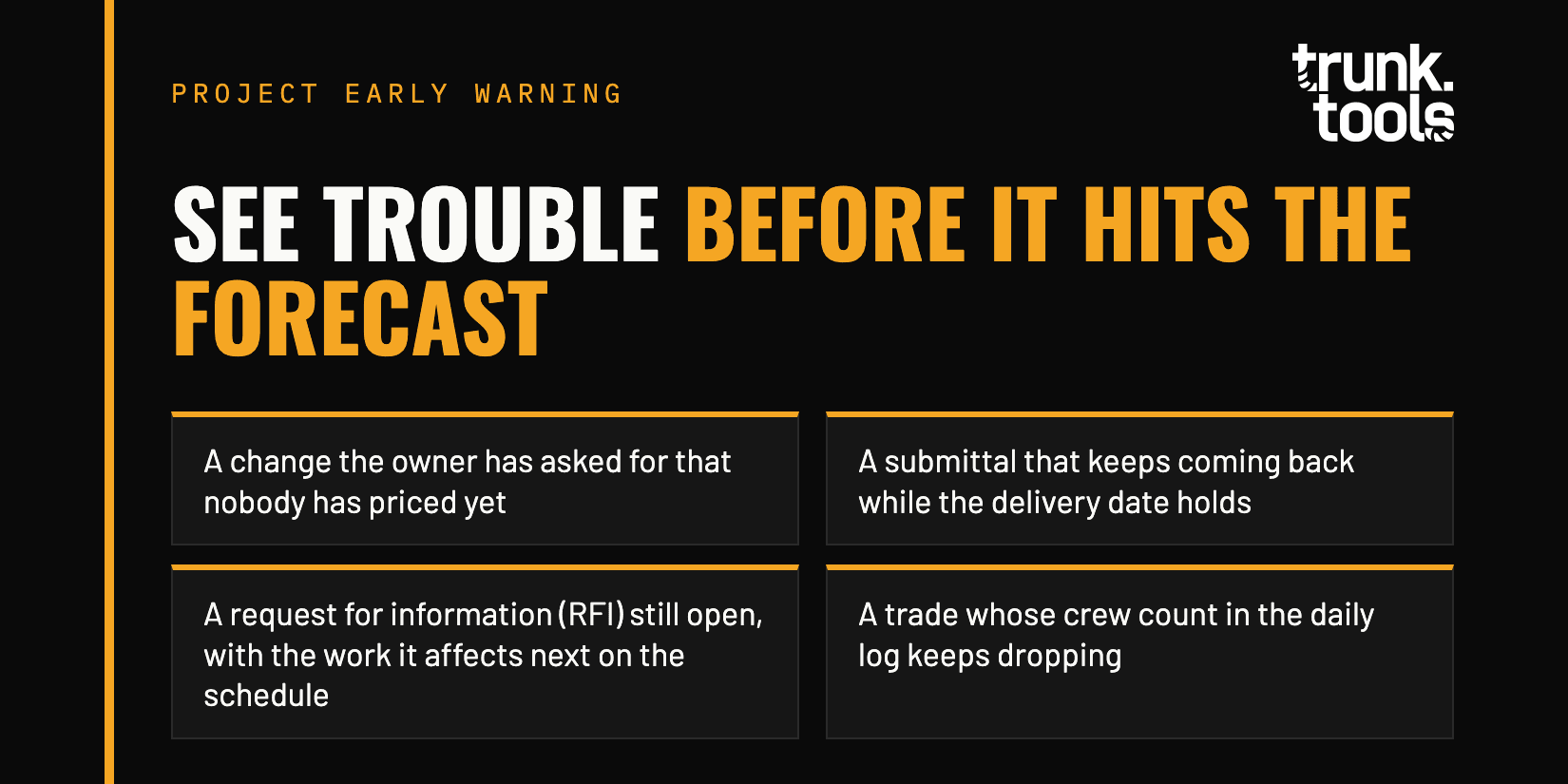
- a change the owner has asked for that nobody has priced yet
- a submittal that keeps coming back while the delivery date holds
- a request for information (RFI) still open, with the work it affects next on the schedule
- a trade whose crew count in the daily log keeps dropping
On its own, each line looks like normal project noise. Together they tell the story of a forecast about to move.
A useful warning carries four things: the job, the sign, why it matters to cost or schedule, and the recommended next step. Call the owner's representative about the unpriced change. Push the architect for the RFI answer before the crew gets there. Re-sequence the work around the late delivery. A warning without a next step is one more report to read.
03 — Scattered knowledge
Why is the warning so hard to get?
The executives at the board named the reason: project knowledge is scattered and keeps getting rebuilt. The signs live in email threads, daily logs, RFI logs, meeting minutes and submittal registers, spread across systems and people. Nobody has time to read across all of it for every job, every week.
The knowledge that turns a sign into a warning is scattered too. Each team relearns what the last job taught: how a certain owner handles changes, which details kept failing inspection, which suppliers slip in the fall. Members want a way to share those skills across teams.
The room also raised what retiring superintendents know. A senior superintendent can walk a site and say this job feels like the one that went sideways. When they retire, that pattern sense leaves with them unless someone captures it first.
04 — Four steps to start
How do you start building early warning into your projects?
You can start before you buy anything:
- Write down your warning signs. Look at your three worst jobs from the last few years and list what showed up before the forecast moved.
- Put the warning where the project executive already looks. The weekly project review and the inbox work better than one more dashboard nobody opens.
- Pair every sign with an owner and a next step. If nobody owns the follow-up, the warning becomes noise.
- Capture what your senior people know. Have experienced superintendents and project managers walk through past jobs and name the patterns, then share them across teams.
These steps make the signs visible. AI helps with the part people cannot keep up with: reading every document on every job and flagging what matches the patterns your team already trusts.
05 — FAQ
Frequently asked questions
Who should get project early warnings?
The project executive first, since they decide where to spend their attention across jobs. The project manager and superintendent on the job get the same warning with the next step that is theirs.
What are the most common early warning signs on a construction project?
Unpriced changes, submittals stuck in resubmittal while the delivery date holds, open RFIs ahead of the work they affect, and crew counts dropping in the daily log.
How does a retiring superintendent's knowledge fit in?
It is what tells you which signs matter. Capture it while they are still on your jobs, so the patterns stay with the company.
By the Trunk Tools team. Published November 23, 2026.
Let builders build
Next step
To see how Trunk Tools reads the documents on your jobs today, book a demo with the Trunk Tools team.